
Use Case to Prediction Model*
*Not Final Name
Salesforce
June 2026 - Ongoing
Agentic Experience Design, Interaction Design, Trust & Safety UX, Information Architecture, Design Strategy, Coded Prototyping
Prediction Models from plain business use cases
An agentic experience that turns a plain-language business question, like "Who will buy winter jackets?", into live predictions a marketer can act on. An AI agent does the technical machine-learning work while the user directs it from above.
The designer led the end-to-end experience, from early concepts to a high-fidelity coded prototype. The work introduced a new Director model, where the user directs and the agent builds, and a trust system that lets non-technical users judge whether a prediction is safe to use.
“My personal anecdotes and thoughts will be in quotes and in blue”
Tools
Figma - Design, FigJam, Make
Skills
Agentic Experience Design
Interaction Design
Information Architecture
Design Strategy
Coded Prototyping
Communication and Presentation Skills
Team
Som Liengtiraphan (Senior Product Designer)
Anastasiya Zdzitavetskaya (Product Manager)
Georgia Paolini (Design Manager)
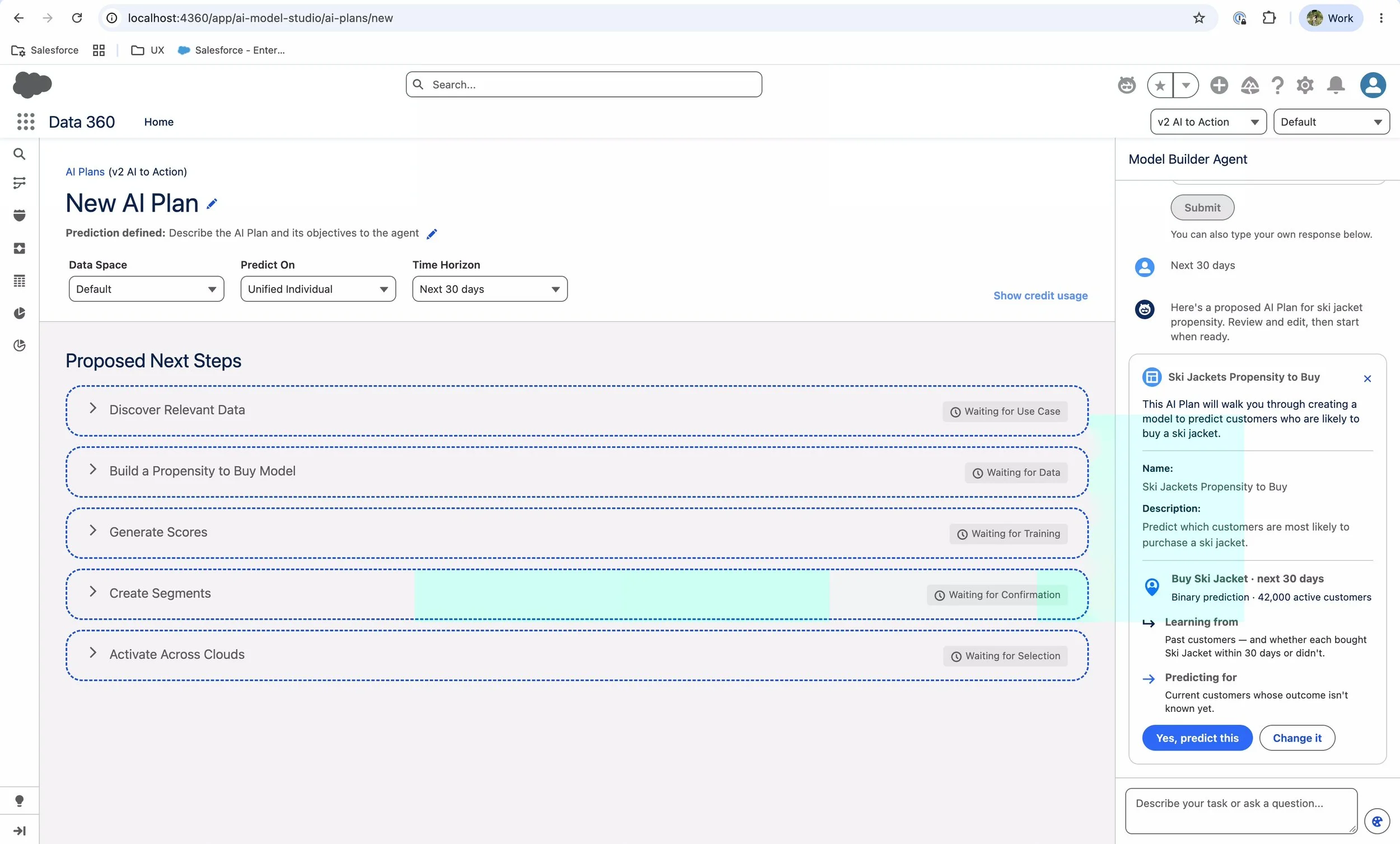
Above: Empty state of the plan before users starts the model building process
Impact and Contribution
Lead designer, owning the experience end to end: the dual-panel workspace, the agent's voice, the model-quality trust system, and the prediction-to-action flow. The designer also built the high-fidelity coded prototype that served as the source of truth for product, engineering, and the Dreamforce demo.
Key Deliverables & Outcomes
Project Context
Defined a human-directed agent model: the agent proposes and does the work, and the user approves or redirects at every key moment
Designed a dual-panel workspace: a structured plan on the left and the agent conversation on the right, kept in sync
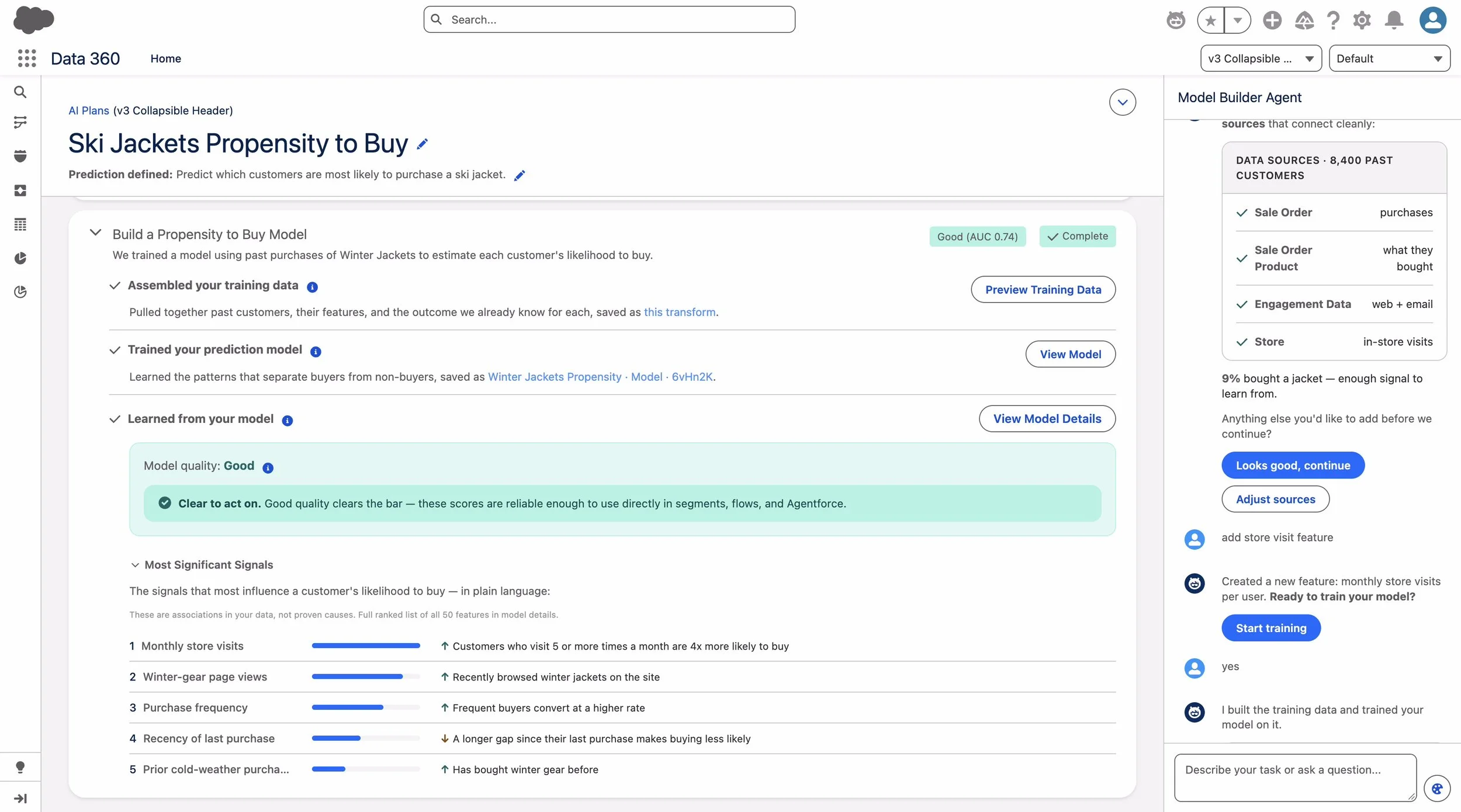
Designed a Good / Fair / Low model-quality system that translates statistics into plain language, with a guardrail that holds back scoring when a model isn't trustworthy
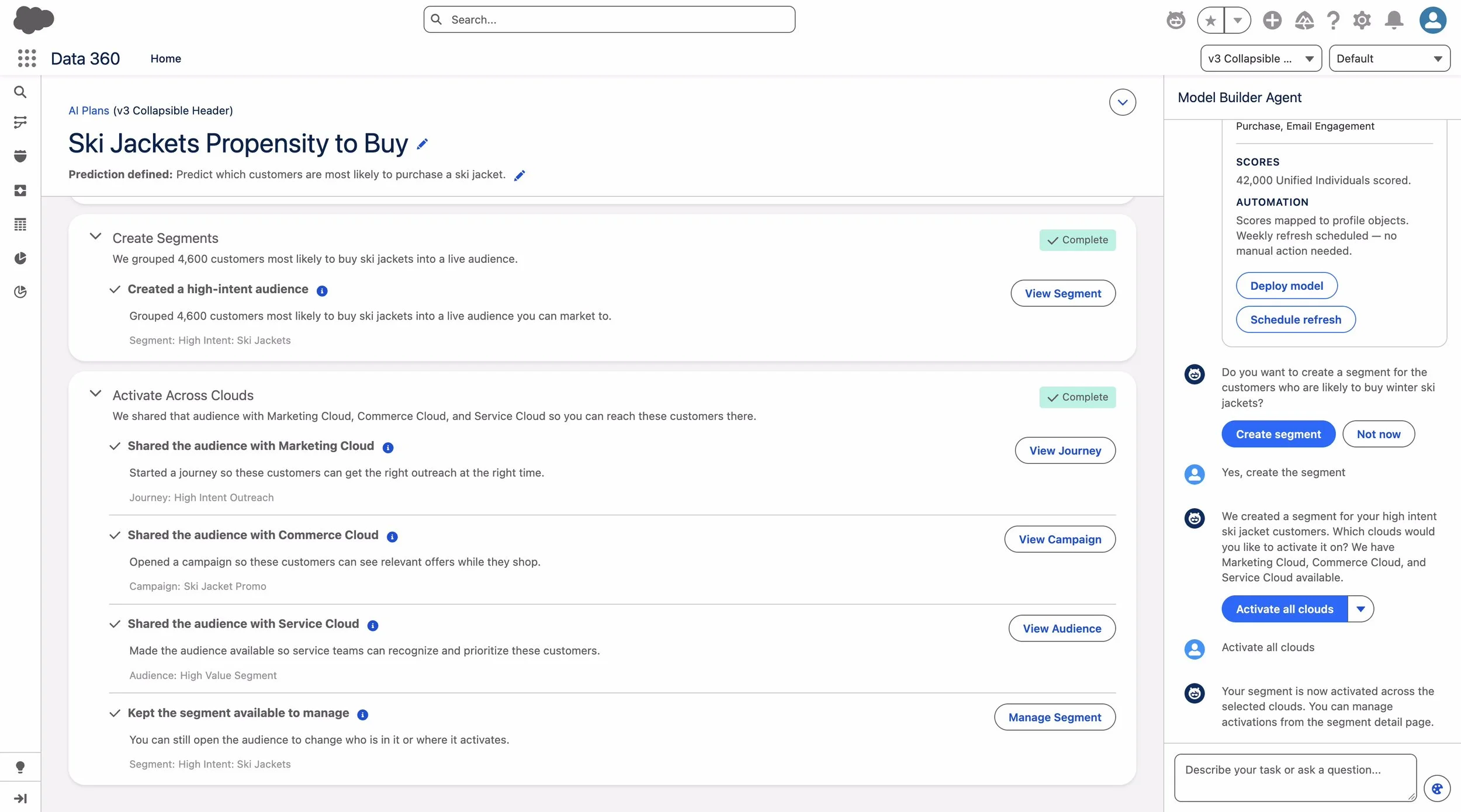
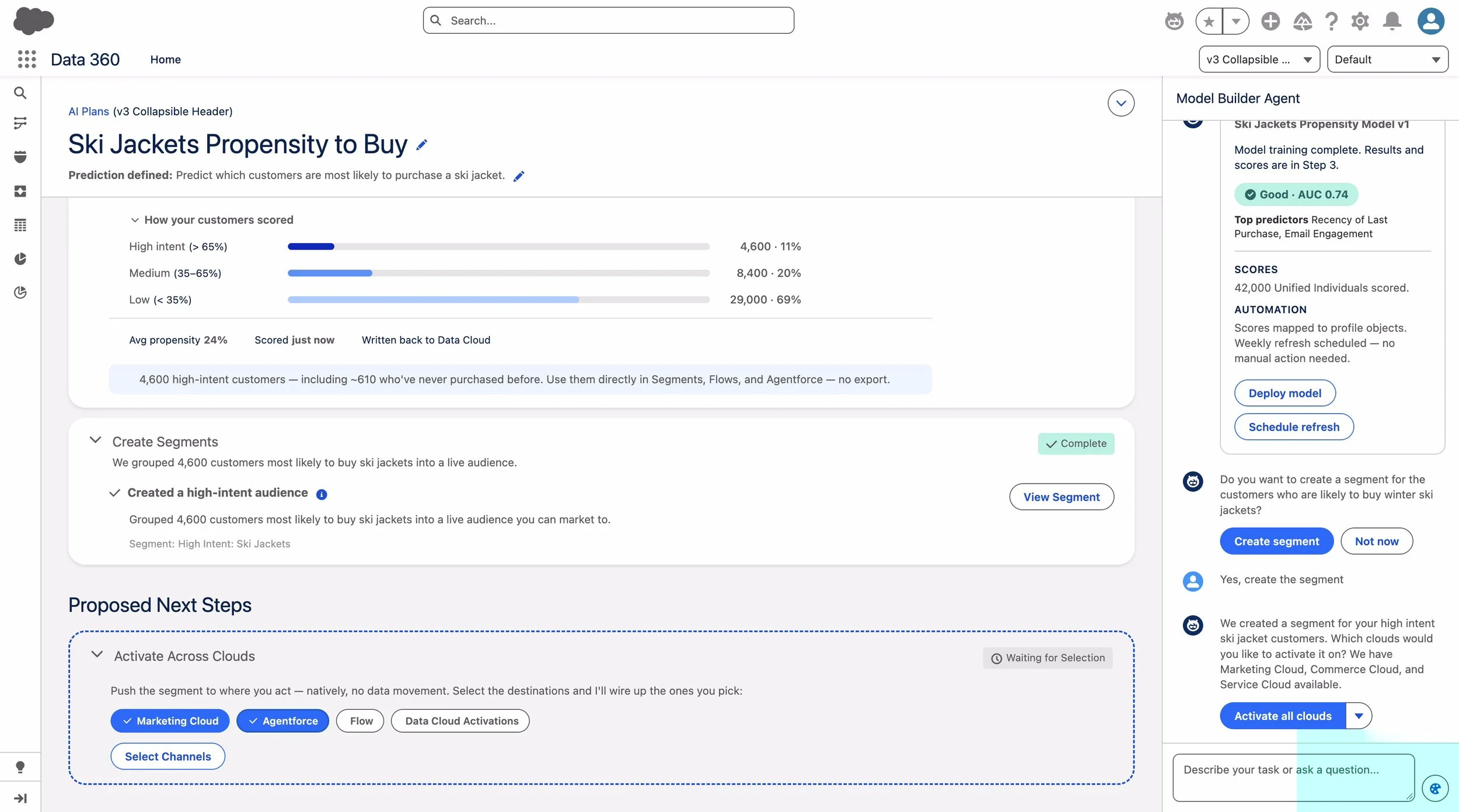
Designed a prediction-to-action flow: from a prediction to a segment to activation across Marketing, Commerce, and Service Cloud in one place
Wrote the agent's voice: candid, plain-spoken, and always ending with a clear next step
Built a coded, click-through prototype in Lightning Web Components, used for stakeholder reviews, usability sessions, and the Dreamforce demo
Most companies have unified their customer data, but very few have a data scientist available to act on it. Interviews, persona research, and a review of existing machine-learning tools showed why predictions stall before they reach a campaign.
Findings:
Persona Mismatch: Existing model-building tools were built for ML engineers. The people who actually need predictions are marketers and business owners who build segments, not pipelines.
The Ticket Queue: Getting a prediction meant filing a request and waiting weeks on a data team. Business owners wanted to serve themselves.
Trust Gap: Users couldn't look at a metric like "AUC 0.74" and know whether it was good. Without a plain-language read, they either didn't act or acted on a bad model.
Disconnected Outcomes: Predictions often ended as a table of scores. The real value is a targetable audience, and getting there meant exporting data and switching tools.
Fear of Costly Mistakes: Users worried about surprise costs and shipping something they couldn't undo.
The Problem
How might we let a business user who can build a segment also build a trustworthy prediction, and act on it, without needing a data scientist?
Goal Metrics
The Users
The experience was designed against clear measures of success:
| Goal | Why it matters |
|---|---|
| Prompt to first live score | The headline promise: question to prediction, fast |
| Data discovery | An early "it already understands my data" moment |
| Human oversight | The agent never makes a consequential move without approval |
| Return rate | Proves the plan is a lasting workspace, not a throwaway chat |
| Context on return | Users pick up exactly where they left off |
| Bad models shipped | Low-quality scores are held back unless the user knowingly overrides |
The primary user isn't defined by a job title. They're defined by owning a business outcome, not the data plumbing.
Business Stakeholders
Tech-savvy stakeholders who steer strategy but don't build pipelines.
Primary Job to Be Done: Proving the value of their data investment with real business results
Feature Needs:
Self-service predictions without a ticket queue
Predictable cost before anything runs
Depth on demand when they want to check the work
Marketing & Operations
Users who prefer visual tools and guided paths.
Primary Job to Be Done: Getting a prediction framed in business terms, not algorithm names
Feature Needs:
Plain-language prompts with examples
A clear Good / Fair / Low quality verdict
No jargon and no blank canvas
Segment Builders
Analysts and marketers who already build segments, dashboards, and activations.
Primary Job to Be Done: Turning a prediction into a targetable audience
Feature Needs:
One-click score to segment
Activation across clouds
Confidence that only trustworthy scores flow downstream
Design anchor: A person who can build a segment should be able to build a prediction.
Scope and Constraints
Scope:
The experience covered the full arc from question to action. Users describe what they want to predict, and the agent discovers relevant data, builds and trains a model, and reviews its quality before generating scores. From there, the plan creates a segment from the scores and activates it across Marketing, Commerce, and Service Cloud. Core functions included natural-language intent, data discovery, feature review, training and scoring progress, tiered quality review, a scoring guardrail with logged override, segment creation, and activation.
Constraints:
The timeline was aggressive, tied to a fixed launch moment. The experience had to stay consistent with the existing Model Builder tool's metrics while serving a much less technical audience. The design also had to handle low-quality models gracefully, recommending a fix rather than leaving the user at a dead end.
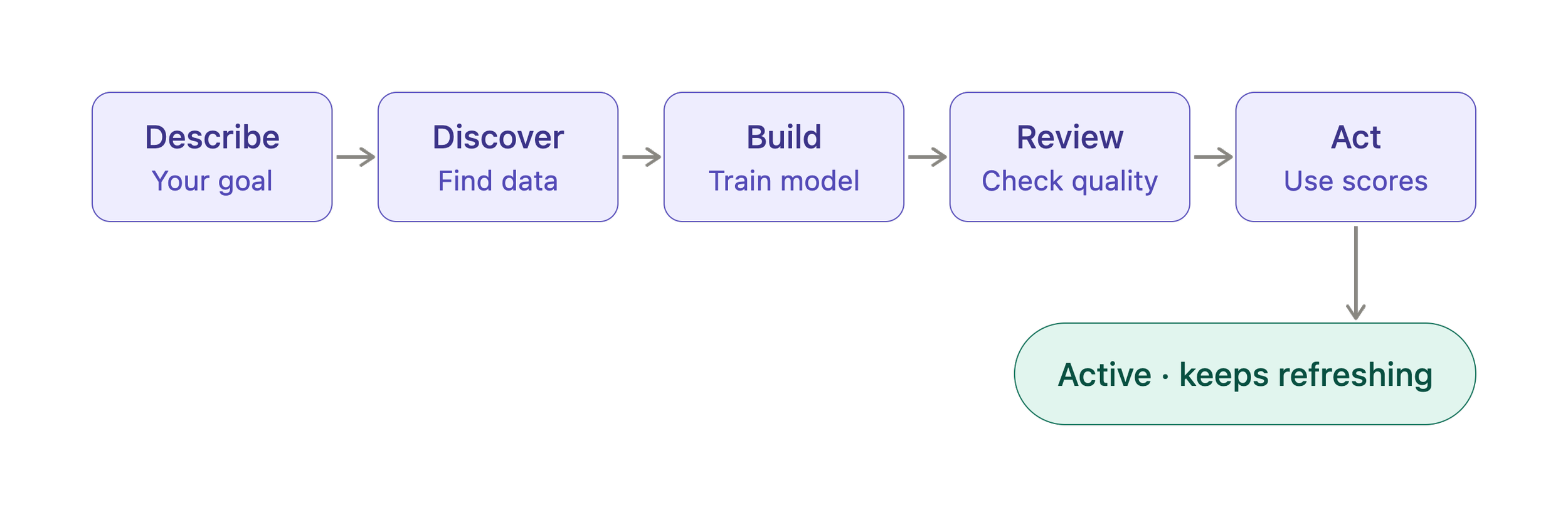
The overall user journey of this project
Experience Maps
An emotional-arc map became the alignment tool across product, engineering, and leadership. Each stage named how the user should feel and the design lever that gets them there.
| Stage | User should feel | Design lever |
|---|---|---|
| Typing the prompt | Skeptical | Plain language, examples, no jargon |
| Data discovery | Impressed | A fast scan that reads as competence |
| First approval | Consulted, not bypassed | A clear proposal with approve or redirect |
| Training wait | Reassured | A visible progress story, not a spinner |
| Quality reveal | Confident, or protected | Good and Fair celebrate; Low is a guardrail |
| Scores to action | Vindicated | One click from score to segment to activation |
| Returning later | Ownership | A confident recap; no "Complete" end state |
Designs That Didn’t Make It
The Wizard
An early direction walked users through a linear series of forms. It felt safe, but it turned the user into an operator clicking Next instead of a director making decisions. It also couldn't handle redirects like "add a feature for store visits." This approach was abandoned.
Full Autopilot
Letting the agent run start to finish was the fastest path, but it broke trust. Users had no moment to weigh in, and nothing stopped a weak model from reaching a live campaign. This approach was rejected in favor of approval moments at each key step.
Chat Only
A pure conversation was flexible but disposable. Decisions got buried in scrollback, and returning users had no clear picture of where their plan stood. This led to the dual-panel layout, with a structured plan as the lasting record.
Metrics First
Early quality screens put accuracy and AUC front and center. Users couldn't judge the numbers, and accuracy could look strong on a weak model. The design moved to a plain-language Good / Fair / Low verdict, with full metrics one click away.
The user starts the building process by describing a business use case they want to solve. From there, the agent will help the users find the correct data and shape it itno the form that’s needed for the prediction model.
Framework
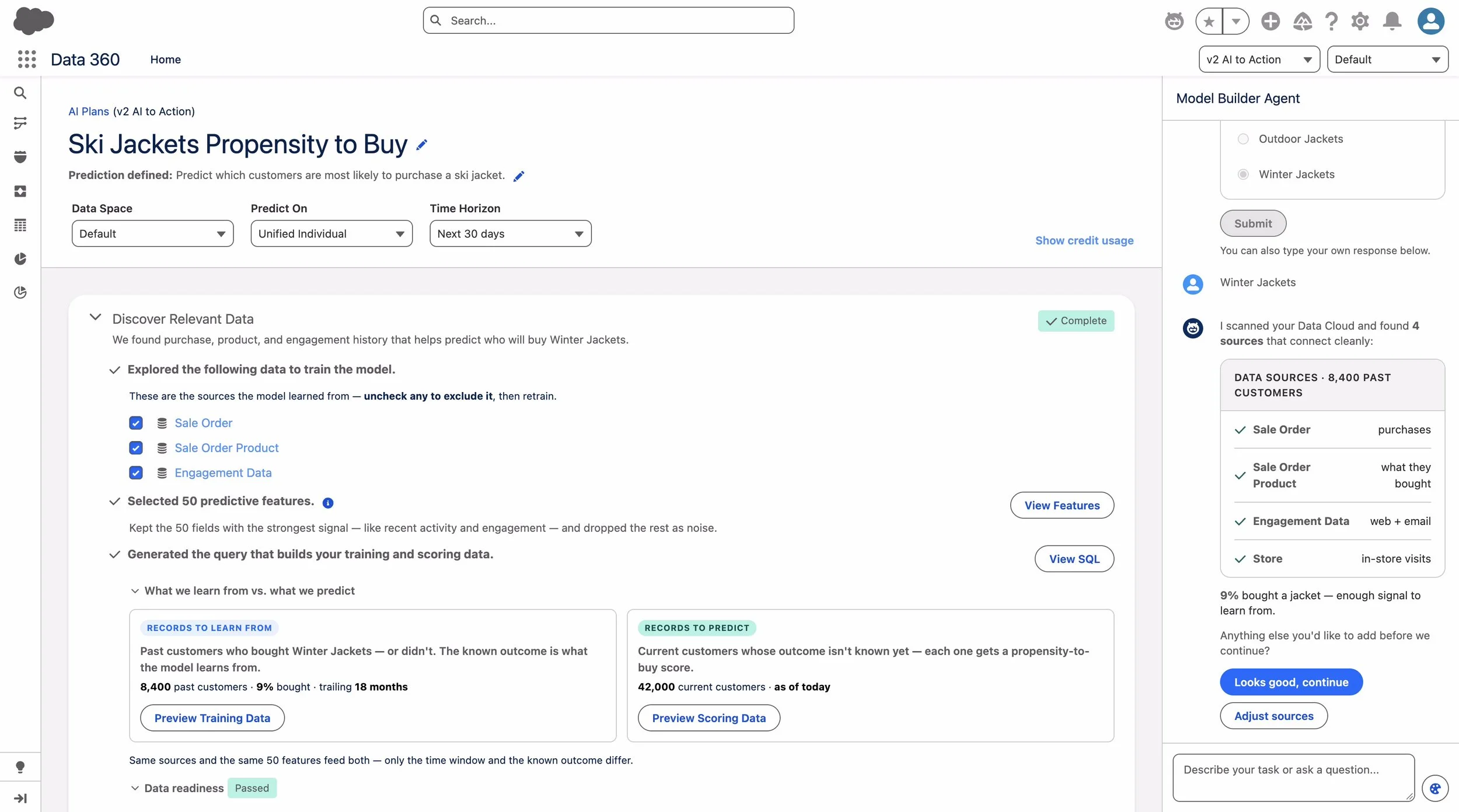
The framework follows how a business owner naturally works: say what you want, check the work, then act. It's built on a dual-panel workspace. The left panel is the plan, a record of what's been decided and what's next. The right panel is the agent, reporting back and asking for direction.
Discover
The user describes what they want to predict in plain language. The agent proposes a plan, finds the relevant customer data, and suggests the signals that matter. The user can add their own, like "add a feature for monthly store visits."
Build
The agent prepares the data and trains the model. A visible progress story (Setting Up, Training, Scoring, Active) turns the wait into work the user can see.
Review
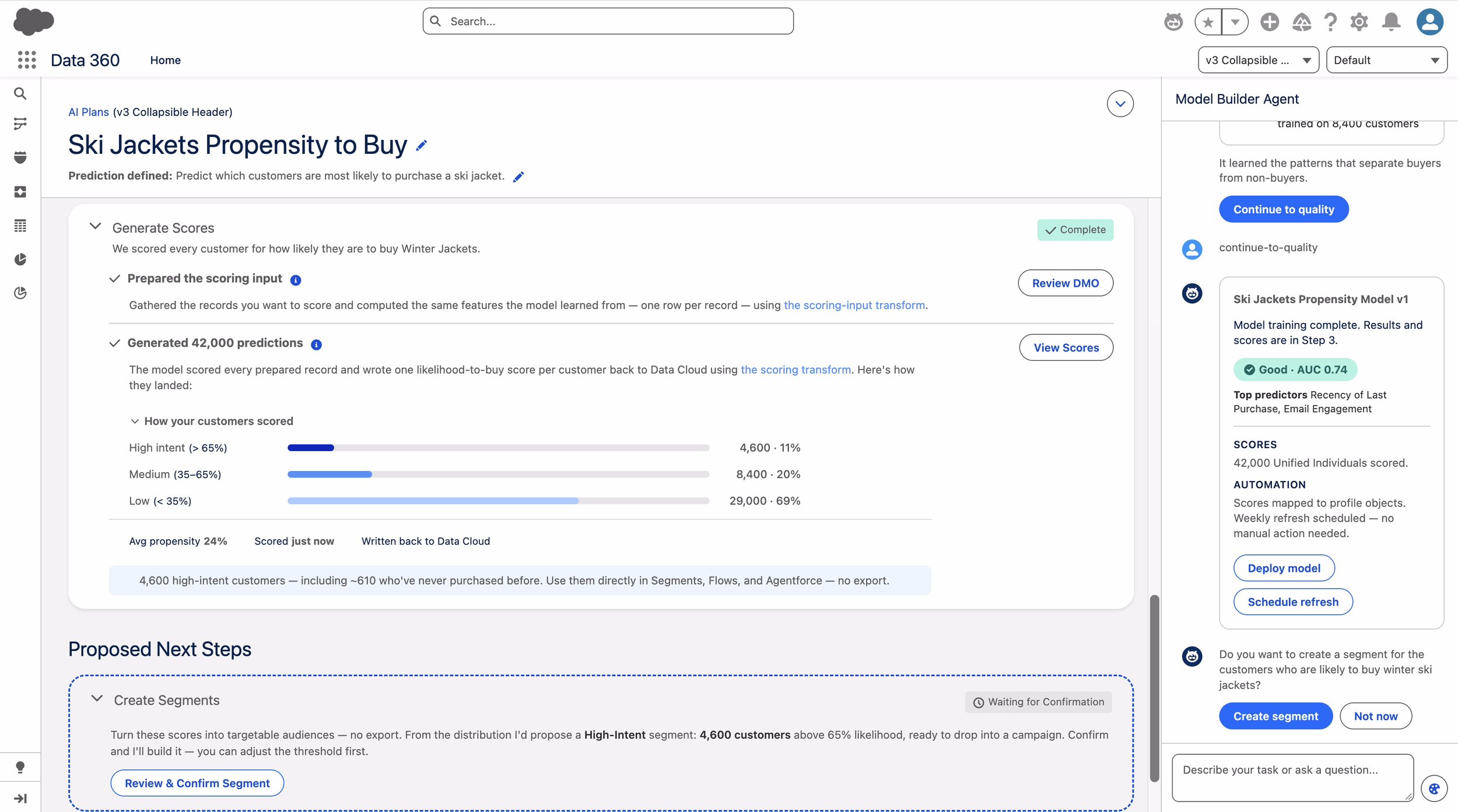
The agent explains model quality in plain language using a Good / Fair / Low scale. Good models score automatically. Fair models score with a caution. Low models are held back, with a clear reason and a recommended fix. The user can override, and the override is logged.
Act
Scores flow straight into action. The agent proposes a segment, such as High Intent: Ski Jackets, and activates it across Marketing, Commerce, and Service Cloud. The plan stays Active rather than "Complete," because predictions keep refreshing as the business changes.
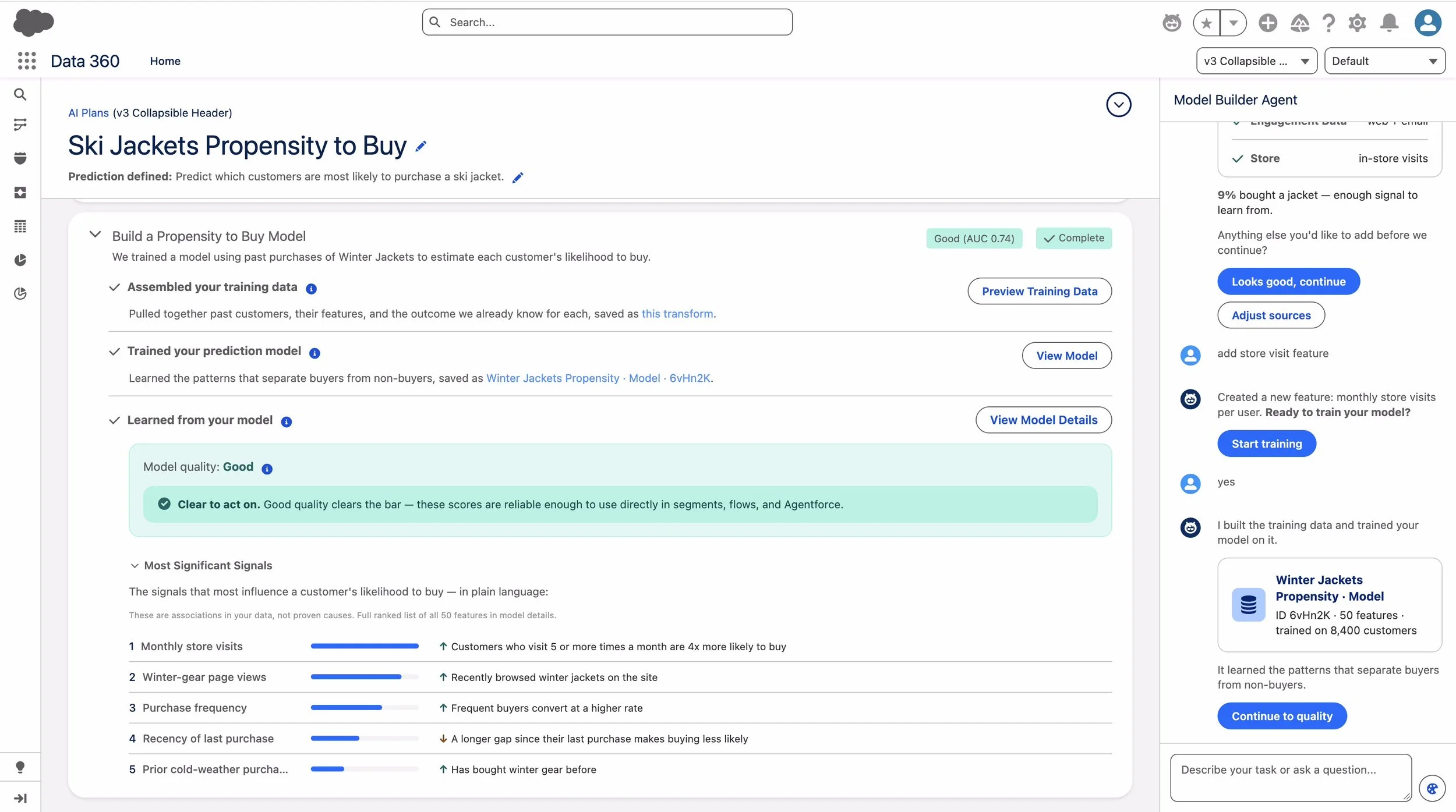
We worked closed with the content design team to ensure that the language we used in this project was friendly to business users with lower data engineering maturity. This ensures that the product will be accessible to our target users.
Platform Integrations
The strategic value lies in connecting a prediction to the places people already work. A trusted prediction gets used, and each use makes the case for the next plan, creating a flywheel effect.
Current Integrations:
Einstein Studio — The home for predictive AI models
Data Cloud — Customer data the agent scans for signals; scores write back with no data movement
Model Builder — Quality metrics mirror the existing tool, adding plain-language tiers on top
Segment Builder — One-click handoff from scores to a generated segment
Marketing, Commerce, and Service Cloud — Activation targets for journeys, campaigns, and audiences
Agentforce — A downstream consumer of scores for agent-led outreach